Stairs & Railings
Stair rise, run & stringer
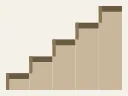
A staircase is really one measurement worked out every way: the total rise, floor to floor. How many steps you get, how tall each one stands, and how deep the treads run all fall out of splitting that single height into equal risers. The one rule you can't bend is that the risers must match - a step that's even a little taller than its neighbours is exactly where people catch a toe.
This calculator does that division for you. Enter the floor-to-floor height and it settles on a step count that keeps every riser in a comfortable, code-friendly range, then pairs it with a tread depth that feels natural underfoot. From there you'll know the horizontal run the stair needs, whether it fits your opening, and how riser height and tread depth trade off against each other.
Guides
Frequently asked questions
How many steps will I need?
Divide the total floor-to-floor height by a comfortable riser height - around 17–19 cm (about 7 in) - and round to the nearest whole number. That result is your riser count; the treads are always one fewer, because the upper floor serves as the final step. A 2.7 m rise, for instance, works out to roughly 15 risers of 18 cm and 14 treads.
What's a comfortable riser-and-tread combination?
The old carpenter's rule still holds: twice the riser plus one tread should come to about 63–64 cm (25 in). So an 18 cm riser pairs naturally with a tread near 27–28 cm. Taller risers call for shallower treads and vice versa - keeping to the rule makes your stride even whether you're heading up or down.
What riser height does building code allow?
It varies by country and often by municipality, but residential stairs generally cap the riser at roughly 19–20 cm (about 7.75 in) and require a tread of at least about 25 cm (10 in). Equal spacing is usually mandated too - the tallest and shortest riser in one flight may differ by only a few millimetres. Confirm the exact figures for your local code before you build.
How deep should each tread be?
Aim for a tread - the part your foot lands on - of at least about 25 cm (10 in) so most of your foot is supported, with 28–30 cm feeling more relaxed on a main staircase. Deeper treads use up more floor length, so a tight or steep space may push you toward the minimum. A nosing, the small overhang at the front, adds a couple of centimetres of foot room without lengthening the run.